

A company brain is the shared, approved picture of your company that every person and every AI app on your team works from. It holds what you decided, what you're aiming at and who does what, with each item marked as current or not. It matters to leaders because, once your team works through AI, whatever the AI believes about your company is what gets done.
That last sentence is the whole argument, so let me slow down and build it from the ground up.
Start from what a company actually is
Strip a company down and you find three things: people, the decisions they've agreed on, and the work those decisions produce. Strategy, culture and process are all decisions, made once and then repeated many times by many people.
For most of history, decisions travelled through people. A leader decided something, told a few people, and they told others. It was slow and lossy, but every carrier was a human who could ask, "Wait, is that still true?"
Now a growing share of the work passes through AI. Your team asks an AI to write the proposal, answer the customer, plan the sprint, draft the hiring post. The AI is a new carrier of your decisions. And unlike people, it doesn't ask if something is still true. It uses whatever it was given.
So the question every leader now faces is: what does your team's AI believe about your company, and who decided that?
What a company brain is
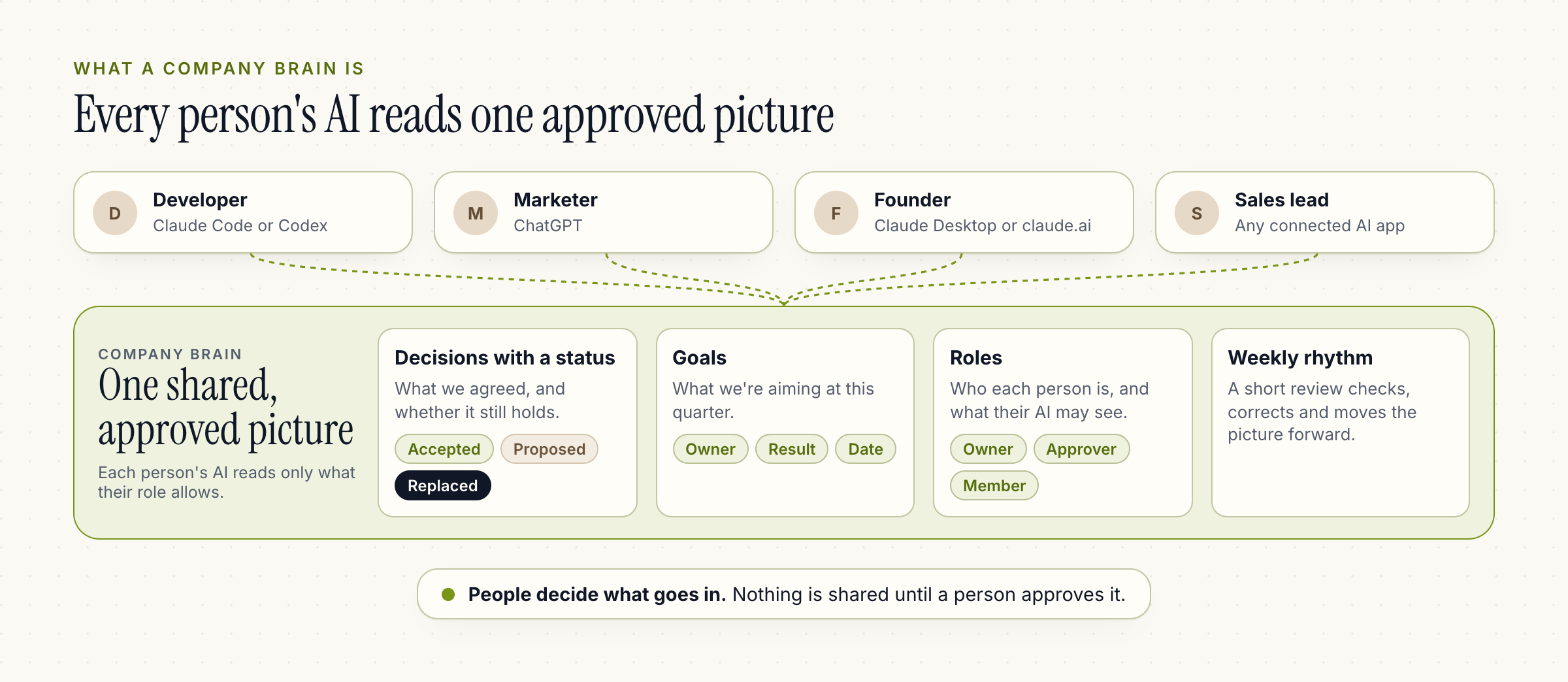
A company brain answers that question deliberately. In practice it has four parts:
- Decisions with a status. Not just notes, but "we decided X", marked as accepted, proposed, disputed or replaced. The status is the point. An AI that can't tell a current decision from an abandoned one will confidently repeat both.
- Goals. What the company is trying to achieve this quarter, who owns each goal and how you'll know it worked.
- Roles. Who each person is and what they work on, so their AI sees what's relevant and permitted for them, not everything.
- A rhythm of updates. A regular moment, often a weekly review, when the picture is checked, corrected and moved forward.
Every person keeps their own AI app. The company brain is the layer underneath that makes their AIs agree.
What it isn't
The term is new and crowded, so it helps to be clear about what doesn't qualify.
It isn't a search box over every file you own. Indexing your drive tells an AI what was ever written down. It doesn't tell it which of the three pricing docs is the real one. More documents often means more confident wrong answers.
It isn't everyone's AI memory pooled together. Personal memory is useful for one person. Pooled, it becomes a pile of private impressions that nobody approved.
It isn't a wiki you hope people update. A wiki is written for humans to browse. A company brain is written so that AI can act on it, which means short, clear, current statements with a status and an owner.
I wrote more about how these differ in agent memory vs company brain vs collaboration layer.
Why this is a leadership job
It's tempting to treat this as a tools decision and hand it to whoever runs IT. I think that's a mistake, for three reasons.
Leaders own the decisions. The hardest part of a company brain is not storing information. It's deciding what's true. Only the people with authority to decide can say "this is our pricing" or "we're no longer pursuing that market". If leaders aren't in the loop, the brain fills with guesses.
AI multiplies whatever you give it. A clear decision, carried by every AI on your team, gets executed consistently a hundred times a week. A vague or outdated one gets executed inconsistently a hundred times a week. The leverage cuts both ways, and leaders are the ones who set the direction it amplifies.
Control has to be designed in, not added later. As AI does more, the question of what it may do without asking becomes central. Who can approve a change to company policy? Who sees financials? Who can mark a decision as replaced? These are governance questions. They belong to leadership from the first day, not after an incident.
What good looks like
From the outside, a team with a working company brain looks calm. A new person connects their AI on day one and it already knows the goals, the customers and the decisions that shape their role. A decision made on Tuesday reaches every relevant person's AI by Tuesday afternoon. Nobody pastes the same background into a chat twice. And when an AI cites a decision, you can see who shared it and whether it's still current.
That's the bar we set for OrgSync. Your AI drafts updates, but nothing is shared until you approve that exact draft. Owners and Decision approvers decide what becomes an accepted company decision. Each person's AI reads only what that person can see, and answers cite what the team shared. It works inside the AI apps people already use: Claude Code, Claude Desktop or claude.ai, Codex and ChatGPT.
Where to begin
You don't need to document the whole company. Start with the decisions that cause the most rework when people get them wrong: pricing, who your customer is, what you will and won't build this quarter, how you talk about the product. Write each one in two or three sentences. Agree that it's current. Give every AI on your team access to it.
Then make reviewing it a habit. A short weekly review is enough to keep the picture honest.
The companies that lead the next few years won't be the ones with the most AI tools. They'll be the ones whose AI tools all know what the company actually decided.
To see how context grows from one chat to a whole company, read the four levels of AI context.
Kaustubh Dhotre, Co-founder, OrgSync