

AI work is climbing a ladder. It started inside a single chat. It moved to the person, then to the project. The next step is the whole company. Each step happens for the same reason: the AI is only as useful as what it knows when it starts, and people get tired of telling it the same things twice. The last step is the hardest, because a company is not one mind. It needs agreement, not just storage.
I spend most of my day with several AI apps open at once. Watching my own habits change over the past two years is how I came to see this ladder. I think most teams are standing on the second or third rung right now, and the fourth is where the real gains are.
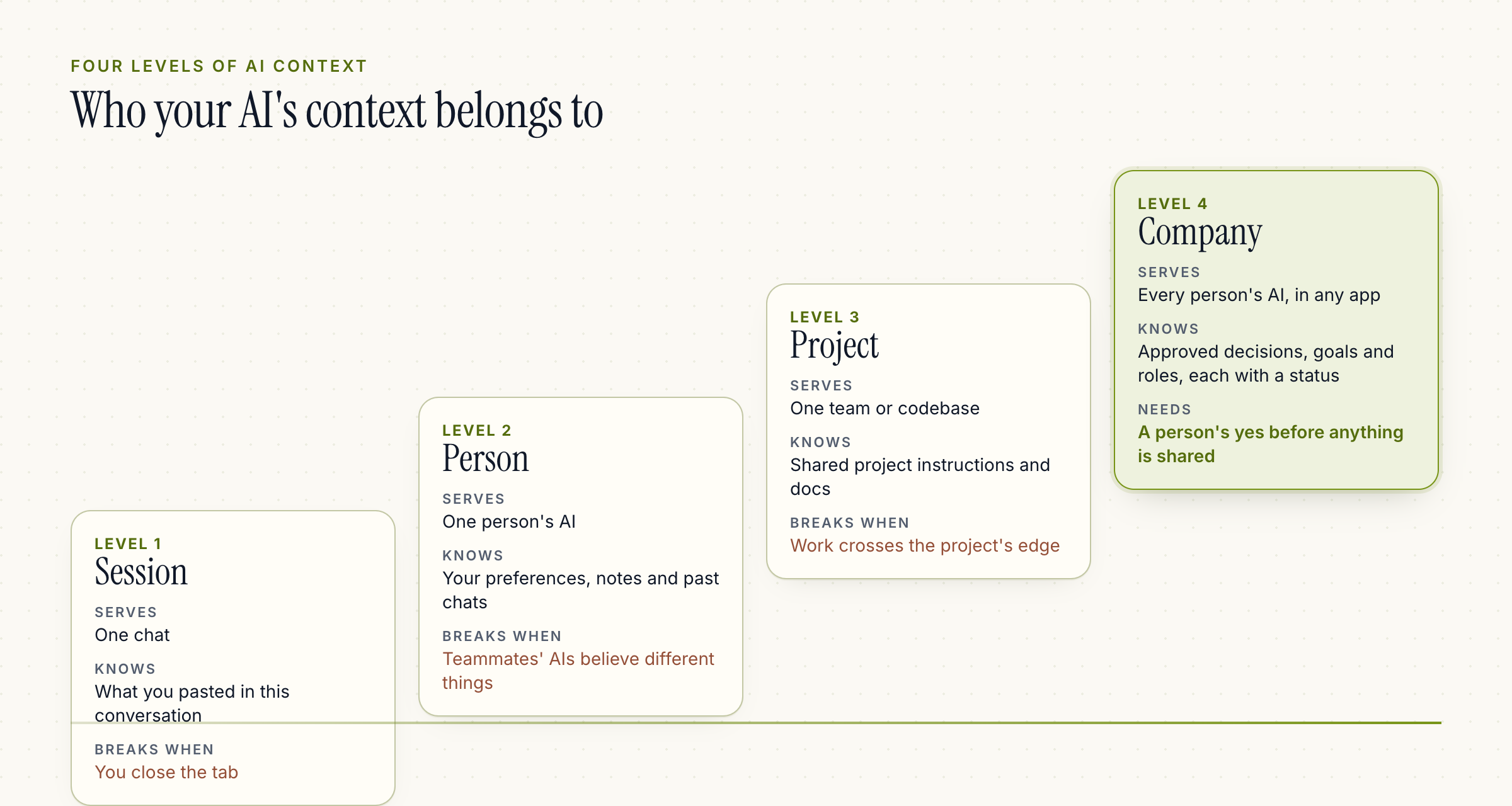
Level 1: the session
In the beginning, every conversation started from zero. You opened a chat, explained who you were, pasted the background, asked your question and closed the tab. Next time, you did it all again.
The unit of context was the session. It was brilliant inside that window and blank outside it. We learned to write longer prompts, keep a notes file of "things to paste first" and copy answers out before they disappeared.
From first principles, the cost here is obvious. The AI's ability was never the limit. Your briefing time was. Every session paid the same setup tax.
Level 2: the person
The next rung was memory for one person. AI apps began to remember your name, your job, how you like answers written, the project you mentioned last week. Custom instructions and saved memories made the AI feel like it knew you.
That was a real improvement. It also created a quiet new problem. Your AI now holds a private picture of the company that nobody else can see. Mine says one thing about our pricing. My teammate's says another. Neither of us knows the other's AI disagrees.
Personal memory makes one person faster. It does nothing for the team, and it can make a team drift apart without anyone noticing.
Level 3: the project
Builders felt that drift first. When several people and several AI tools work in the same codebase, a private memory per person is not enough. So teams started writing context into the project itself: a shared instructions file at the top of the repository, a project knowledge space, a folder of docs the AI reads before it starts.
We do this ourselves. Two different AI coding tools work on OrgSync every day, and they read the same project guidance file. When we change how something should be done, we change it once, and both tools pick it up.
Project context is the first level where the context belongs to a group rather than a person. That is the important shift. But it has a boundary. The repository knows how the code should be written. It does not know what sales promised a customer last Tuesday, which goal this quarter matters most, or which decision the founder reversed this morning. And it only reaches the people who work in that project.
Level 4: the company
The final rung is context that belongs to the company. Not a bigger document folder, and not everyone's memories pooled together. Something closer to what a good chief of staff carries in their head:
- What we decided, and whether that decision is current, proposed or replaced.
- What we're aiming at, as goals with owners and dates.
- Who is who, so the right person sees the right things for their role.
- What changed, so nobody works from last month's plan.
This is what people now call a company brain. The name matters less than the job: every person's AI, in whatever app they prefer, starts from the same approved picture of the company.
Here is the part that makes level 4 genuinely different from the three before it. At levels 1 to 3, the AI could just write things down. At level 4, it can't. A company is a group of people who have to agree. If any AI can quietly add "facts" that every other AI then repeats, you have built a very fast rumour mill. So the company level needs something the lower levels never did: a person's yes before something becomes shared truth, and clear rules about who sees what.
That is the design choice at the heart of OrgSync. Your AI can draft a company update in seconds. It stays private until you approve that exact draft. The right people decide what becomes an accepted company decision. And when anyone's AI answers a question about the company, it cites what the team actually shared.
Where this goes next
Climbing to level 4 changes what work looks like. Here is what I expect over the next year or two.
Briefing disappears as a task. Today a surprising share of knowledge work is re-explaining context: to a new hire, to a teammate, to an AI. When the company's context travels with every request, that work shrinks to almost nothing. People will notice it mostly as the absence of a chore.
Every person works with several AIs, and they agree. People will keep choosing their own tools. The developer lives in a terminal, the marketer in a chat app, the founder in both. That's fine. The company layer doesn't ask everyone to switch; it makes their different AIs consistent.
AI starts doing work, not just answering. The next wave is AI that carries a task from start to finish inside a company: following up, preparing the weekly numbers, drafting the plan for review. We're building toward AI employees that work this way, each with a responsible person. That only works safely when the AI starts from approved company context and its authority is as clear as a new hire's.
The scarce thing becomes judgment. When execution gets cheap, the bottleneck moves to deciding: what matters, what we stand behind, what we'll change. The companies that move fastest will be the ones that make decisions clearly, write them down once and let every AI carry them forward.
What this asks of leaders
If you lead a team, the practical question is simple: which rung is your company on?
If your people each brief their own AI, you're on level 2. If one team keeps a shared instructions file, that team is on level 3. Level 4 starts the day a decision made in one meeting reaches every person's AI, correctly, without anyone pasting it in.
You don't need a big rollout to start. Pick the five decisions people most often get wrong. Write them down plainly. Agree that they're current. Then make sure every AI your team uses can see them. That's the first company brain, and you can grow it one decision at a time.
If you want to see what that looks like in practice, read what a company brain is or connect your AI apps to OrgSync.
Kaustubh Dhotre, Co-founder, OrgSync