

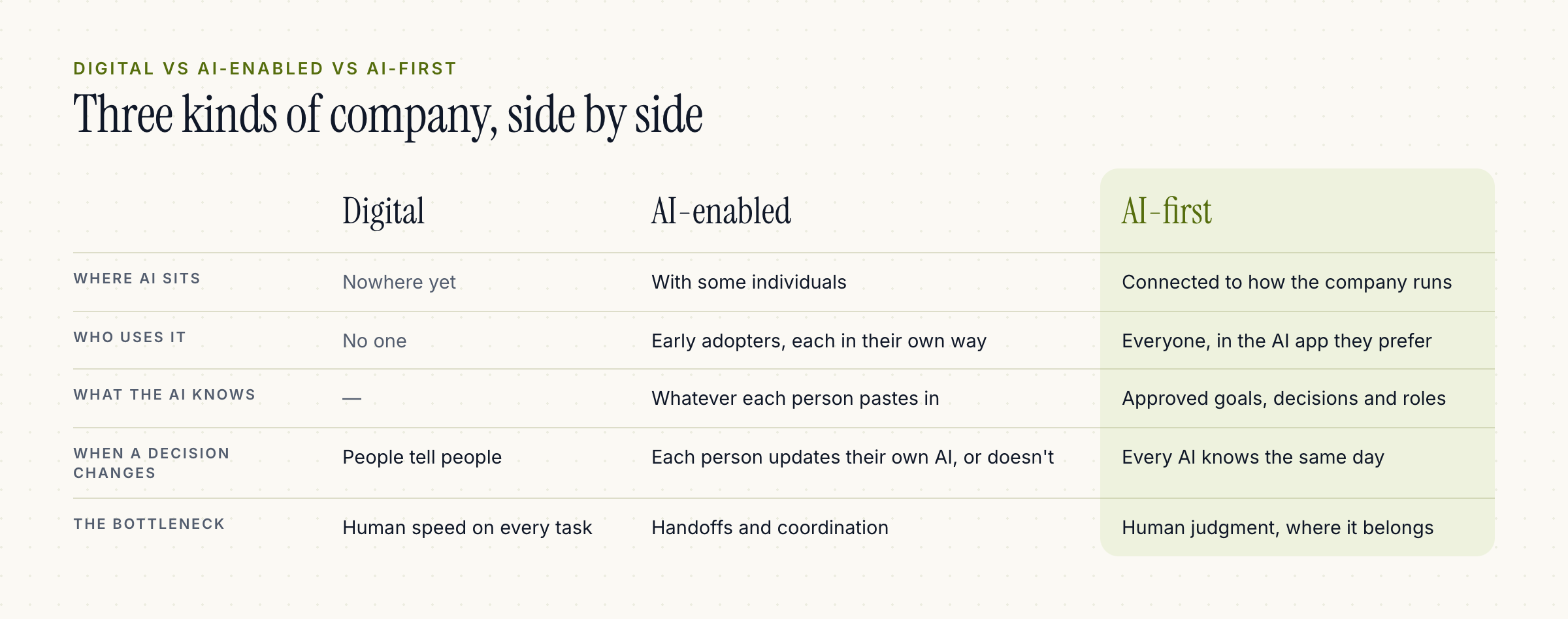
A digital company runs its processes on software but doesn't use AI yet. An AI-enabled company has individuals using AI to speed up their own work and automate parts of the business. An AI-first company connects AI to the whole organisation, from strategy and management to day-to-day delivery, so every person's AI works from the same goals and decisions. Each step can multiply what a team gets done, but the biggest jump comes from the last one, and it's the one most companies haven't made yet.
I talk to founders every week who say "we're an AI company now". Usually they mean everyone has a chat subscription. That's a real step, but it isn't the destination. Here's how I think about the three stages, and roughly what each one is worth.
Stage 1: the digital company
A digital company has moved its work onto software. Email instead of letters, a CRM instead of a card file, cloud documents, a project board, online payments. Most companies reached this stage over the past twenty years.
What changed: information became searchable and shareable. Work could happen from anywhere.
What didn't: every piece of thinking, writing and deciding is still done by a person, at human speed. Software stores and moves the work; people do all of it.
Where time goes: writing, analysing, preparing, and a large share spent finding information and waiting for each other.
Stage 2: the AI-enabled company
In an AI-enabled company, some people use AI to do their own work faster. A marketer drafts posts with an AI app. A developer writes code with an AI pair programmer. Support uses AI to suggest replies. Someone automates the weekly report.
What changed: individual tasks got much faster. The evidence is real. In one large study, customer support agents using an AI assistant handled nearly 14% more issues per hour (NBER). In a controlled experiment, developers with an AI pair programmer finished a coding task 55.8% faster (arXiv).
What didn't: the company itself. AI sits with individuals, not with the organisation. Each person briefs their own AI, in their own way, with their own version of the facts. Nobody's AI knows the company's goals, last week's decisions or what a teammate is doing. So the gains stay local:
- The marketer's AI writes faster, but from last quarter's positioning.
- The developer ships faster, then waits two days for a product decision.
- Five people get five different answers about the same pricing.
This is where most companies are today. It's a real improvement, but it plateaus, because the slow part of a company was never one person's typing speed. It was the handoffs between people.
Stage 3: the AI-first company
An AI-first company doesn't just give people AI. It connects AI to how the company runs.
- Strategy: goals live where every AI can read them, with owners, results and dates. When a person asks their AI to plan their week, it starts from the company's priorities.
- Management: decisions are written down once, approved by the right people, and marked as current or replaced. Weekly reviews check progress against goals and carry what was learned forward.
- Delivery: every person's AI, in whichever app they prefer, works from the same approved context. Requests between people say what's needed, by when and for which goal.
What changed: the company now has a shared brain, not just smart individuals. Decisions reach every AI the day they're made. Handoffs carry their context with them. Leaders can see whether work is moving towards the goals without a status meeting.
What stays human: judgment. People decide what's true, what matters and what the company stands behind. In an AI-first company, people approve, and AI carries the decision forward faithfully. That balance is what makes it safe to give AI more of the work.
This is what we build OrgSync for. It connects each person's AI app (Claude Code, Claude Desktop or claude.ai, Codex and ChatGPT) to one Company Brain with your goals, decisions and weekly reviews. Nothing becomes shared until a person approves it, and each person's AI sees only what their role allows.
How much difference does each stage make?
No one has clean, company-level measurements for this yet, so treat what follows as a thinking tool, not a promise. It's a simple model with assumptions you can change for your own team.
Assumptions for a 10-person team:
- About 40% of each person's time goes to work AI can speed up: writing, analysis, coding, preparing.
- About 30% goes to coordination: finding context, waiting for decisions, status updates, rework from outdated plans.
- The rest is work AI doesn't change much: conversations with customers, deep judgment calls, relationships.
Digital company: this is the baseline. Software makes the work possible, but people do all of it at human speed.
AI-enabled company: say half the team uses AI on their own tasks and gets those tasks done 30% faster, which is conservative against the studies above. That frees about 6% of the team's total time (half the people × 40% of their time × 30% faster). Coordination time doesn't move, and may even grow, because faster individuals create more work that needs someone else's input. Rough gain: about 5–10% more capacity.
AI-first company: now everyone's AI starts from shared context, so say the whole team gets 40% faster on those same tasks. That frees about 16%. Because decisions and context reach every AI directly, assume coordination time falls by a third, which frees another 10%. Rough gain: about 26% more capacity, roughly a quarter. That's like adding two or three people to a team of ten without hiring.
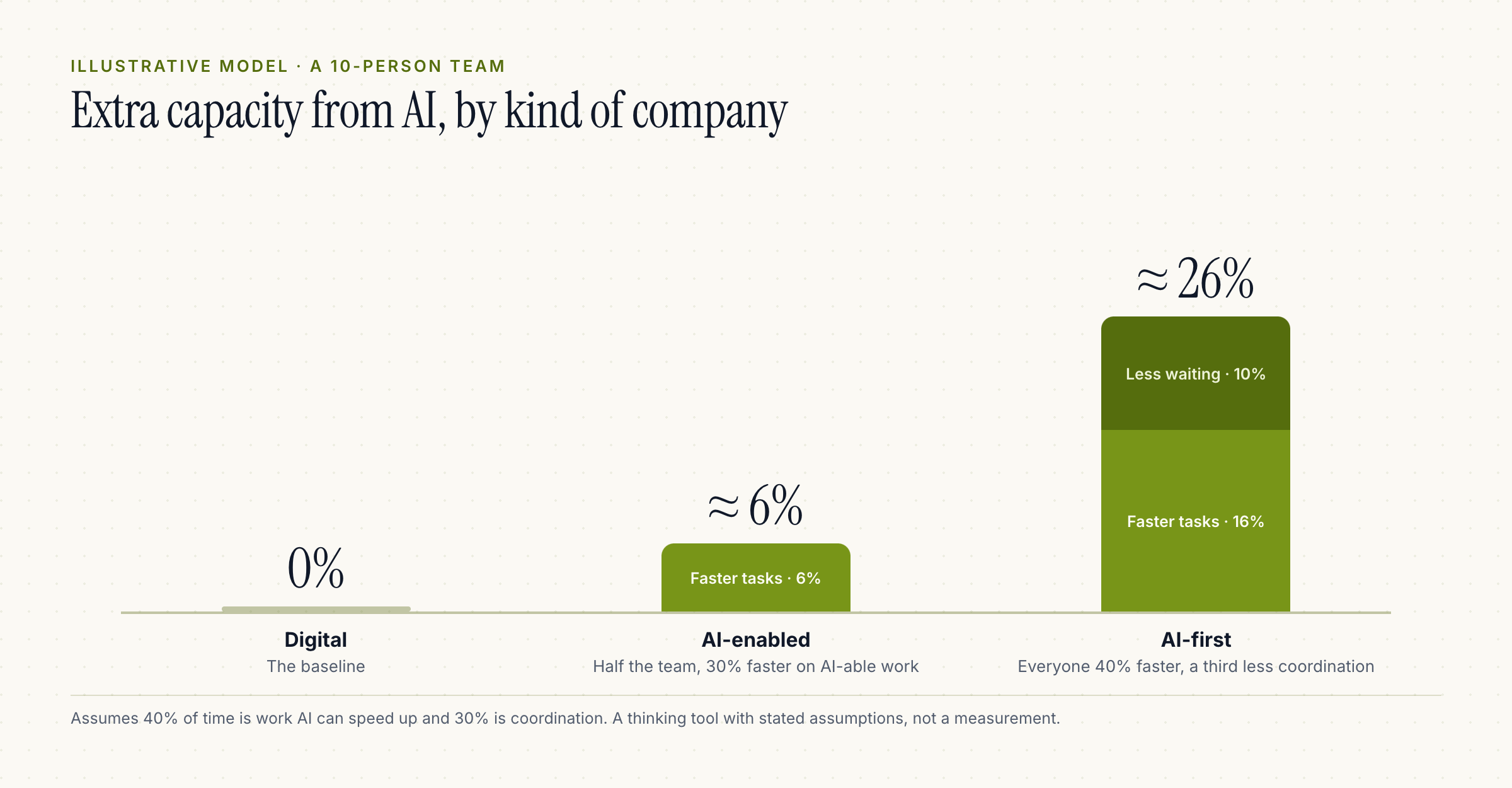
The numbers matter less than where they come from. The AI-enabled gain is capped by how many people use AI and by coordination overhead that stays the same. The AI-first gain comes from both directions at once: faster individual work and much less waiting. The second source is the one most companies leave on the table.
There's a quality effect the model doesn't count. When every AI works from the same current decisions, there's less work to redo. In my experience, avoiding one week spent building on a reversed decision is worth more than a month of faster drafting.
How to tell which stage you're in
Ask three questions:
- If I change a key decision today, how many people's AI will know by tomorrow? If the answer is "only those I tell", you're AI-enabled at best.
- Can a new hire's AI explain our goals and current priorities on their first day? If not, the company's context isn't connected to its AI.
- When two people ask their AI the same question about the company, do they get the same answer? If not, each AI is working from its own version of the truth.
Moving from AI-enabled to AI-first
You don't need a transformation programme. The move is smaller than it sounds:
- Write down the decisions that matter most. Start with five: who your customer is, pricing, this quarter's priorities, what you've said no to, how you describe the product.
- Agree they're current. The right person approves each one.
- Connect every person's AI to them, in the apps people already use.
- Set goals your AI can see, with owners and dates.
- Review weekly. Check progress, record what changed and set next week's priorities.
Do that, and your company stops being a group of people who each use AI and becomes a company that runs with AI.
To see how context grows from one chat to a whole company, read the four levels of AI context. To get started, share company context across your AI apps.
Kaustubh Dhotre, Co-founder, OrgSync