

AI has made individual work dramatically faster, yet most companies don't feel faster. The reason is that company speed was never set by how quickly one person works. It's set by the handoffs between people: waiting for context, waiting for a decision, waiting for someone to confirm the plan hasn't changed. People aren't the bottleneck. The gaps between them are.
I want to be careful with this argument, because there's a lazy version of it that says "remove the humans". That's not what I mean, and I think it's wrong. Let me explain from first principles.
A simple model of company speed
Picture any piece of work that matters: a customer proposal, a launch, a hiring decision. Break it into steps and you'll find two kinds of time.
- Work time: someone is actually doing the thing. Writing, building, analysing.
- Wait time: the work is sitting still. Waiting for an answer, an approval, a meeting, a missing piece of context.
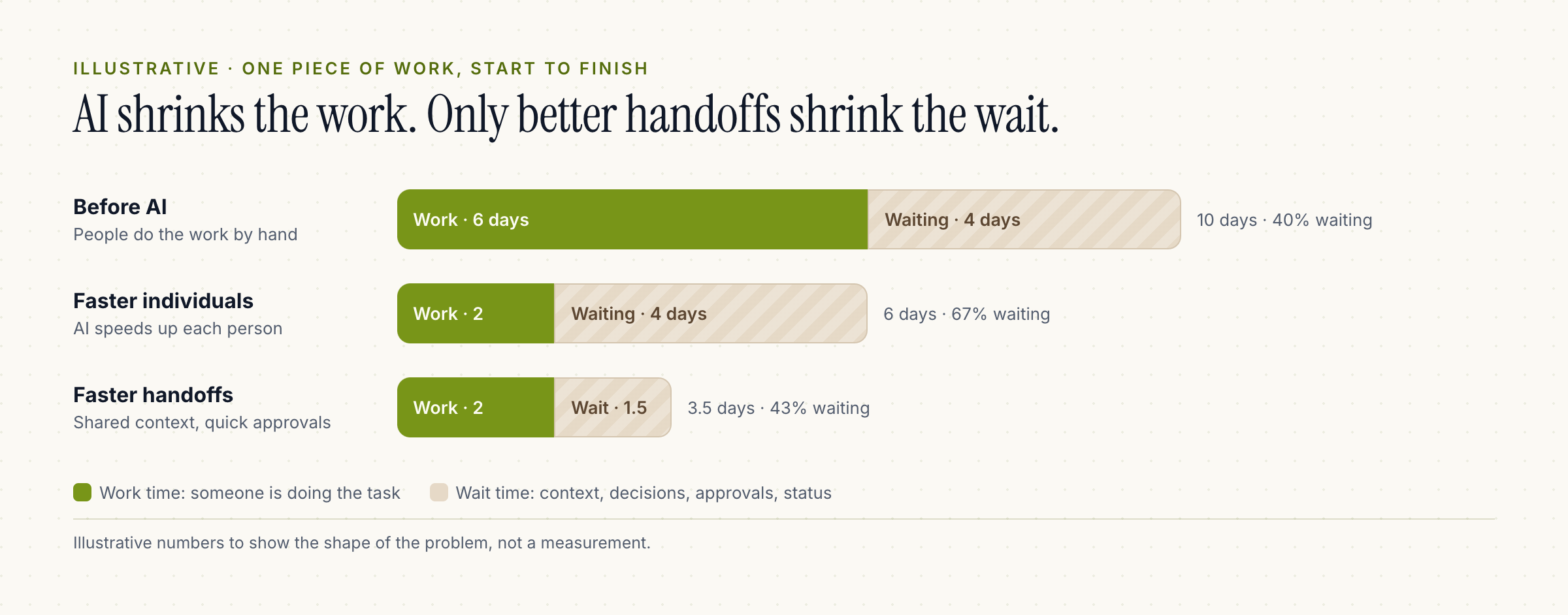
Before AI, work time was large, so nobody looked closely at wait time. Now AI compresses work time. A draft that took a day takes twenty minutes. Analysis that took a week takes an afternoon.
But wait time didn't shrink. In many teams it grew, because people now produce more work that needs someone else's input. So the share of time spent waiting went up. Make one step ten times faster and the step after it becomes the limit.
That's why AI adoption often feels like a personal win and a company shrug.
Where the waiting actually happens
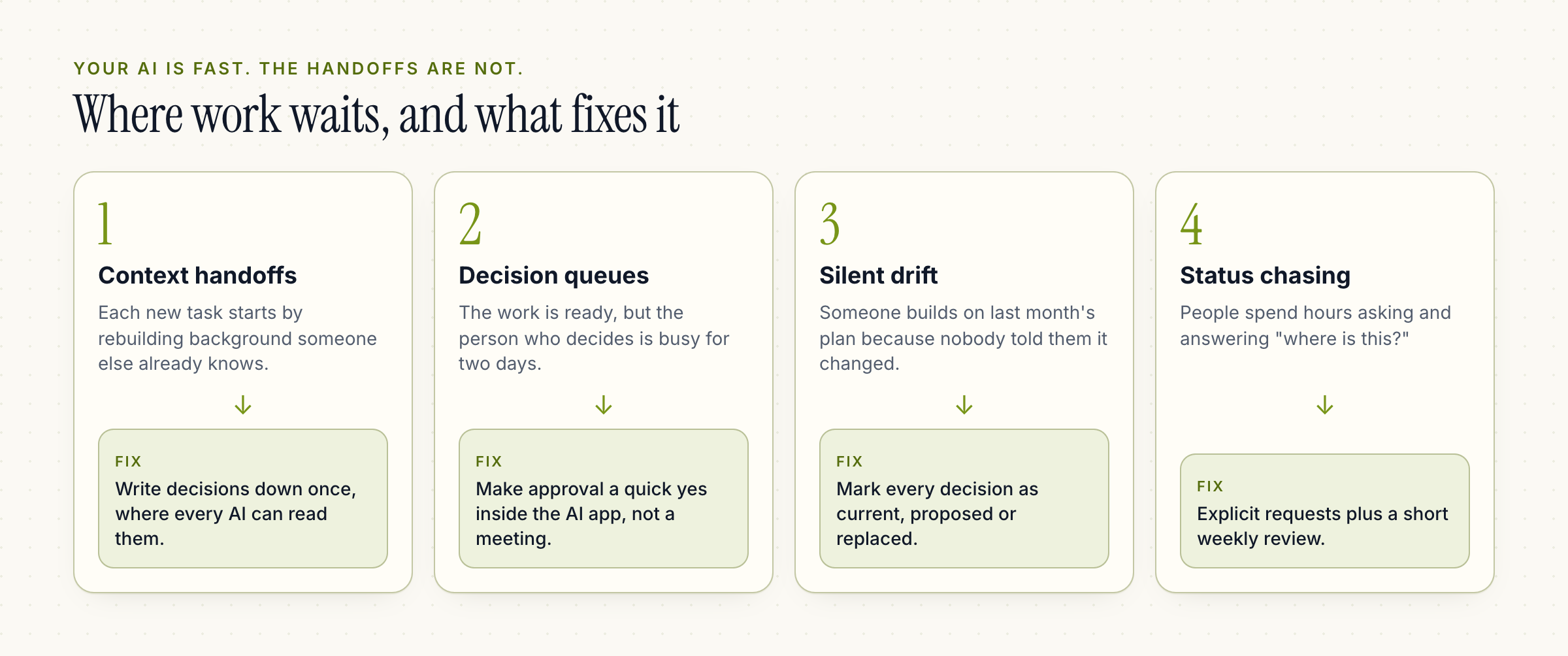
When I look at where work stalls, in our own company and in the teams I talk to, it falls into four places.
1. Context handoffs. Someone picks up a task and spends the first hour, or the first message to their AI, reconstructing background. What did we promise this customer? Which pricing applies? Who decided that? The information exists, but in someone else's head or someone else's chat.
2. Decision queues. The work is ready, but it needs a decision from a person who is busy. The decision itself might take two minutes. Getting it takes two days.
3. Silent drift. Someone works hard from an old plan because nobody told them it changed. This is the most expensive wait of all, because it doesn't look like waiting. It looks like progress until it's thrown away.
4. Status chasing. People spend time asking where things are, and other people spend time answering. Meetings exist largely to synchronise state that could have been visible.
Notice that none of these are problems of human ability. They're problems of how information and authority move between humans.
Why "remove the humans" is the wrong fix
You could try to eliminate the waiting by letting AI decide things on its own. Skip the approval, let the agent change the plan, let it update the shared facts.
It's tempting, and it fails for a simple reason: the decisions that cause the most waiting are the ones that need judgment and accountability. What we charge. Who we serve. What we promise. When an AI changes those without a person, you haven't removed the bottleneck. You've removed the ownership, and the cost shows up later as rework, confused customers and a team that no longer trusts what their AI tells them.
The better question is: how do we keep humans in charge of decisions while making the handoffs around those decisions nearly instant?
How to make handoffs fast
Here's what I've seen work, and what we've built OrgSync around.
Write decisions down once, where every AI can read them. Most context handoffs are really "tell me what we decided". If decisions live in one shared, approved place, every person's AI already knows them. The hour of briefing becomes zero. In OrgSync, any teammate's AI can answer a question about the company with citations to what the team shared.
Make approval a quick yes, not a meeting. Approval should happen where people already work. When your AI drafts a company update, OrgSync asks you to approve that exact draft right inside your AI app. Owners and Decision approvers can accept decisions the same way. The decision stays human; the queue gets short.
Mark what changed. Drift happens when old and new decisions look the same. Give every decision a status, current, proposed or replaced, so an AI working from an old plan is told it's old.
Make requests explicit. "Can you look at this?" in a chat is easy to lose. A request with a recipient, a due date, a definition of done and the goal it moves is hard to lose. In OrgSync, /orgsync:request turns that into a request the teammate can agree to. A peer's request becomes a commitment only when they accept it.
Replace status meetings with a weekly review. A short weekly review, where each person checks in on goals and shares the decisions worth keeping, does most of what status meetings do, in a fraction of the time. It also keeps the shared picture honest. Try /orgsync:review.
What leaders should measure
If you want your company to get faster with AI, stop measuring only how much AI your people use. Start asking:
- How long does a new task take to start, from assignment to first real work?
- How long does a typical decision wait for the person who has to make it?
- How often does work get redone because someone used an outdated plan?
Those three numbers tell you more about your company's speed than any count of prompts.
The real opportunity
The first wave of AI made individuals faster. The next wave will make teams faster, and it won't come from smarter models alone. It will come from companies that treat context and decisions as shared infrastructure, so that every handoff carries what the next person needs and every decision reaches every AI the moment it's made.
People stay at the centre of that picture. They make the calls, own the outcomes and decide what the company stands behind. We just need to stop making them wait for each other.
For the bigger picture, read the four levels of AI context or what a company brain is.
Kaustubh Dhotre, Co-founder, OrgSync