

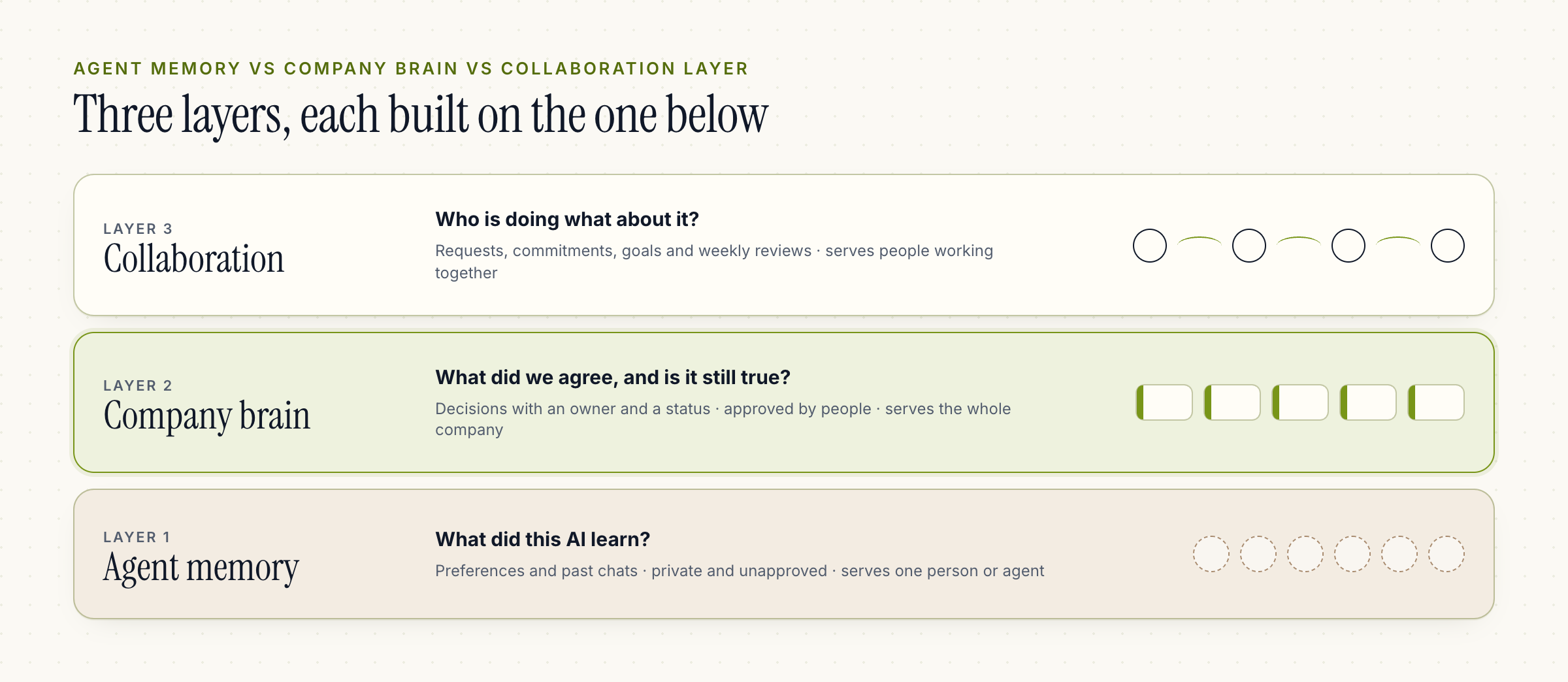
Agent memory, a company brain and a collaboration layer solve three different problems. Agent memory helps one AI remember what it learned. A company brain gives a whole team one approved picture of what the company decided. A collaboration layer moves work, requests and accountability between the people and AIs doing it. Most confusion comes from treating them as one thing. They stack: each needs the one below it.
I get asked about this almost every week, usually as "isn't this just memory?". It's a fair question. Here's how I think about it.
Agent memory: what one AI remembers
Agent memory is the AI keeping notes for itself. It remembers that you prefer short answers, that your project uses a certain framework, that you mentioned a deadline last week. Some memory lives in the AI app you use. Developers also give their own agents memory stores so an agent can pick up where it left off.
What it's good at: continuity for one person or one agent. Less repeating yourself.
What it can't do: tell you whether a memory is true for the company. Memory records what was said, not what was agreed. If I told my AI in March that we target agencies, and we changed our minds in May, my AI still believes March unless I correct it. My teammate's AI may believe something else entirely. Neither memory has an owner, a status or an approval.
The test: ask, "Who decided this?" Agent memory has no answer. It just knows it heard it.
Company brain: what the company agreed
A company brain is shared context that the company stands behind. Its basic unit is not a memory but a decision: a short statement with an author, a status (accepted, proposed, disputed, replaced) and the people who can see it.
What it's good at: making every person's AI agree. When a decision changes, it changes once, for everyone. When an AI answers a question about the company, it can cite the decision and show whether it's current.
What it needs that memory doesn't: people. Someone has to approve what becomes shared, someone has to decide what's accepted, and access has to follow roles so the intern's AI doesn't read the board pack. That human step is not friction to remove. It's the feature. It's the difference between "something an AI wrote down" and "something we agreed".
The test: ask, "Is this still true, and who said so?" A company brain can answer both.
I wrote a longer piece on what a company brain is and why leaders should care.
Collaboration layer: how work moves between people
A collaboration layer sits on top. It's about action, not knowledge: who asked whom for what, by when, against which goal, and whether it got done. Requests, commitments, check-ins and weekly reviews live here.
What it's good at: keeping a team pointed at the same goals and making handoffs explicit. A request becomes a commitment only when the person agrees. Progress is visible without a status meeting.
Why it depends on the company brain: collaboration without shared context is just a fancier to-do list. A request like "prepare the renewal offer" only works if the person and their AI know the current pricing decision, the customer's history and the goal it serves. Without that, every handoff starts with a briefing.
The test: ask, "Who is doing what, for which goal, and has it moved?"
How they stack
Think of it as three questions, each building on the last:
| Layer | Question it answers | Unit | Who it serves |
|---|---|---|---|
| Agent memory | What did this AI learn? | A memory | One person or agent |
| Company brain | What did we agree? | A decision with a status | The whole company |
| Collaboration layer | Who is doing what about it? | A request, goal or review | People working together |
From first principles: you can't coordinate work without agreeing on facts, and you can't agree on facts if every AI holds its own version. So memory alone doesn't scale to a team, and collaboration tools without a shared brain spend their time re-explaining context.
Why the line between them matters now
For a while, these distinctions felt academic. Most teams used AI one person at a time, and memory was enough. That's changing fast. Teams now run several AI apps across several people, and AI is starting to carry tasks from start to finish. Once that happens, three things break if you only have memory:
- Conflicting answers. Two people ask their AI the same question and get different answers, both confident.
- Stale direction. A reversed decision lives on in a dozen private memories.
- Unclear authority. Nobody can say which AI is allowed to change what.
A company brain fixes the first two. A collaboration layer, built on top of it, fixes the third by making responsibility explicit.
Where OrgSync sits
We built OrgSync as a company brain first, with collaboration on top. Your AI drafts a company update; nothing is shared until you approve that exact draft. Owners and Decision approvers decide what becomes an accepted decision. Each person's AI reads what their role permits and answers with citations. On top of that, goals, weekly reviews and requests to teammates use the same shared context, so a handoff carries what the next person needs.
We don't replace your AI's memory. Keep it for your preferences and habits. Just don't ask it to be the place where your company decides what's true.
If you want to try this across the AI apps your team already uses, start with sharing company context across Claude, ChatGPT and Codex.
Kaustubh Dhotre, Co-founder, OrgSync